Voliro Launches Smart Batteries for the Voliro T: Hot-Swap Power That Keeps Industrial Inspection Missions Running
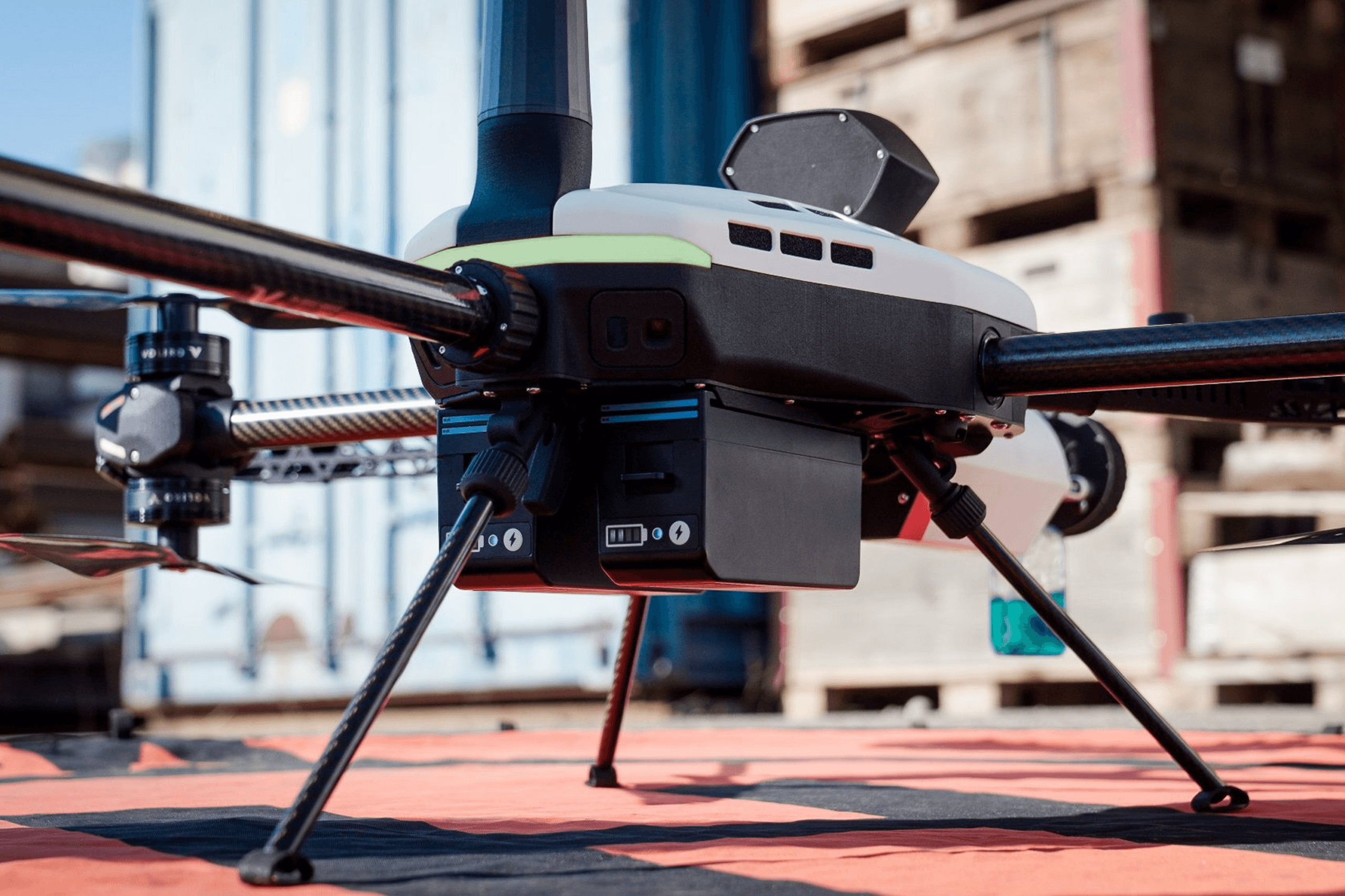
Voliro has launched Smart Batteries for the Voliro T: Hot-swappable, self-managing power units designed specifically for robotic industrial inspections. Back in the air in under 20 seconds. Built-in health monitoring. IATA compliant for air travel. And self-heating down to -10°C for operations in any climate.
What makes Voliro Smart Batteries a game changer in robotic industrial inspections
The direct cost recovery from faster battery swaps is quantifiable. The indirect benefit (what becomes possible when the platform operates continuously) is harder to quantify but arguably more significant.
When inspection sessions are no longer bounded by battery cycles, campaigns can be planned around asset access windows instead.
In professional robotic industrial inspections, how you manage power shapes almost everything: how many runs you complete in a day, how confident your team feels about finishing a mission, whether you can send one pilot to a remote site or need to send two.
Hot-swappable power. Swap batteries without powering down the Voliro T. The second battery keeps the system running while you replace the first. Back in the air in under 20 seconds.
IATA-compliant for air travel. Compliant IATA TABLE 2.3.A batteries designed for hassle-free travel that go wherever the job is. Batteries must be carried in hand luggage.
In every Voliro T subscription. Smart Batteries are included with every new Voliro T. Existing subscribers will receive their upgrade as part of the phased rollout. Contact your account manager for availability.
Voliro Smarter Batteries do not just store more energy. They give time back:
Hot-swappable — back in the air in under 20 seconds. Swap a depleted battery without powering the Voliro T down. Instead of planning your day around downtime, you plan around continuous availability. For contact-based inspection, LPS testing, and spot repair at height — where access windows close and assets go back into service — this changes everything.
Self-managing power. The batteries detect their own state and switch automatically between flight, charging, and storage modes. Batteries left fully charged for extended periods degrade faster. The Voliro Smart Battery handles storage protection on its own — no manual intervention, no degraded cells showing up on a critical job six months later.
Self-heating — operations down to -10°C. Cold batteries behave unpredictably and can fail suddenly under load. Self-heating capability before power delivery removes that entire category of risk for teams working in northern climates, offshore platforms, or through winter inspection seasons.
Real-time telemetry — know exactly what you have. Live State of Charge (SOC), State of Health (SOH), and voltage data for both batteries simultaneously through the app. The difference between knowing your battery is at 73% and healthy versus guessing based on charge time is the difference between a confident decision and an anxious one.
The Voliro Smart Batteries are IATA Table 2.3.A compliant for air travel — carried in hand luggage, on any commercial flight, anywhere in the world. Combined with the smart charger’s 110–240V AC worldwide input and simultaneous charging of up to three battery pairs, the entire power system is genuinely global. Plug in anywhere. Get back to work.
The Voliro T’s full payload application list illustrates what continuous operation makes possible:
Ultrasonic Testing (UT) — Complete, uninterrupted wall thickness maps on tanks, vessels, and structural steel without seam artifacts from repositioning.
High-Temperature UT — Assets running at up to 260°C / 500°F inspected live, without cooling or scaffold. Time-critical in turnarounds where cooling an asset adds days to the schedule.
EMAT — Non-contact thickness measurement with no couplant required. Faster surface-to-surface transitions, more coverage per session.
Dry Film Thickness (DFT) — Coating verification across large surface areas. Higher spatial resolution and more complete coverage per campaign.
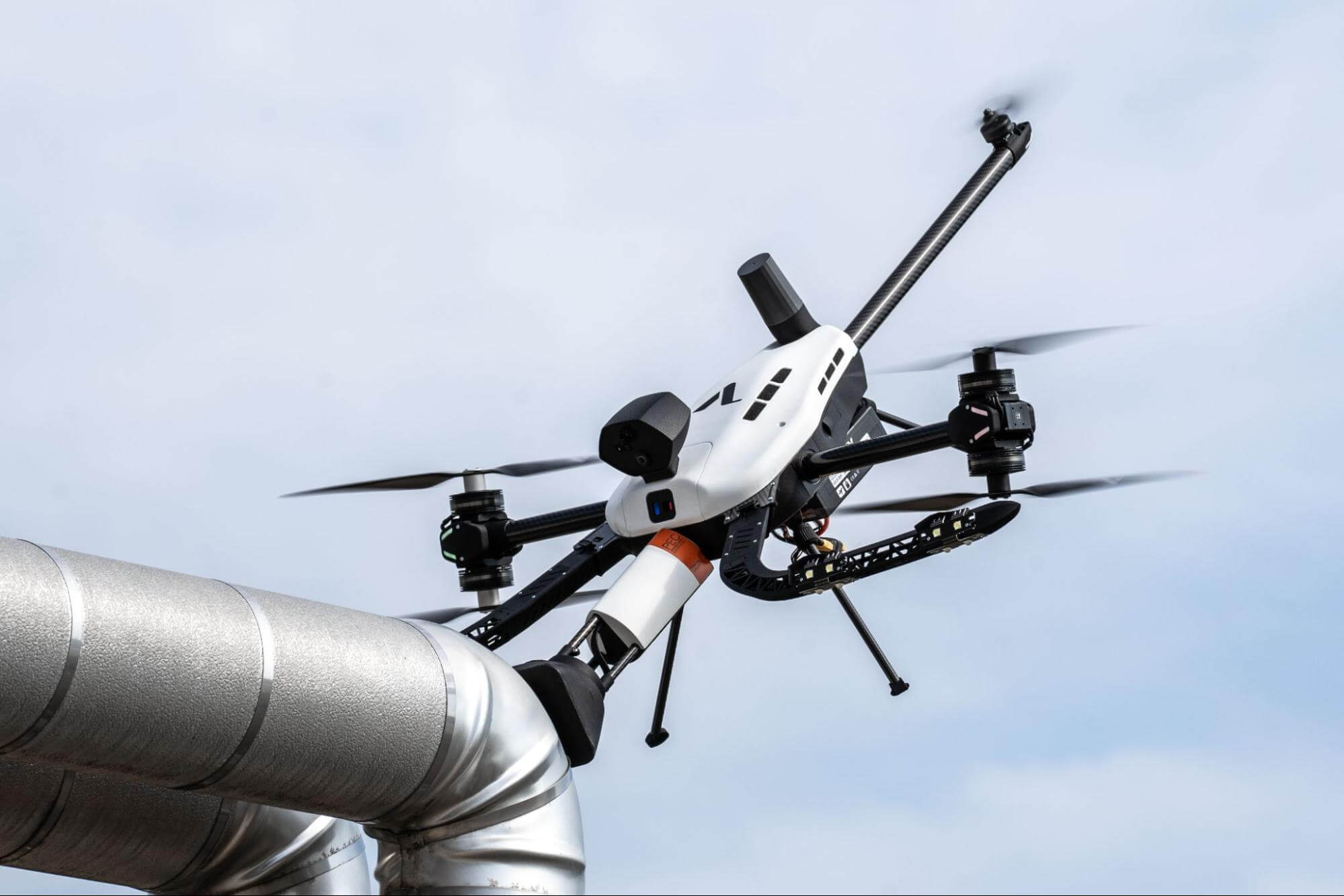
Pulsed Eddy Current (PEC) — Corrosion screening through insulation without removal. The most economically significant aerial NDT method currently in production — and the one where data continuity matters most.
Wind Turbine LPS Testing — Full lightning protection system verification. Previously requiring rope access or multi-day scaffold construction; now achievable in a single continuous session.
What this means for how inspection platforms should be evaluated
The conventional evaluation framework for drone-based NDT platforms focuses on sensor specifications, payload compatibility, flight time, and software integration. These are necessary criteria. They are not sufficient ones.
The evaluation criteria that determine whether a platform delivers value in production, across a full campaign, in real industrial conditions, inside the economic context of a live turnaround include:
Inspection throughput per turnaround window. Not flight time. Not battery capacity. The actual amount of inspection scope that can be completed per hour of access time, accounting for all battery handling, repositioning, re-initialization, and setup between flights.
Data continuity across session boundaries. Whether the dataset produced by a multi-flight campaign holds together as a coherent, defensible record or whether it contains joins, gaps, and re-initialization artifacts that complicate integrity reporting.
Platform operating envelope in real deployment conditions. Actual reliable performance at the temperatures, wind conditions, and site environments where the platform will be used. A platform that operates at −10°C with automated thermal management and IATA-compliant batteries for international air travel is a fundamentally different tool from one that requires favourable conditions and freight logistics planning.
Total cost per inspection session. Including crew time, mobilisation, battery handling, re-initialization, repositioning, and the probability of requiring a return visit due to incomplete or fragmented data.
When evaluated on these criteria rather than peak sensor specification or single-flight demonstration performance, the economics of platform design decisions that appear minor in a spec sheet comparison become clearly material.
Ready to see it in action?
Book a 20-minute virtual demo whether you are evaluating the Voliro T for the first time or looking to optimize your current operations.