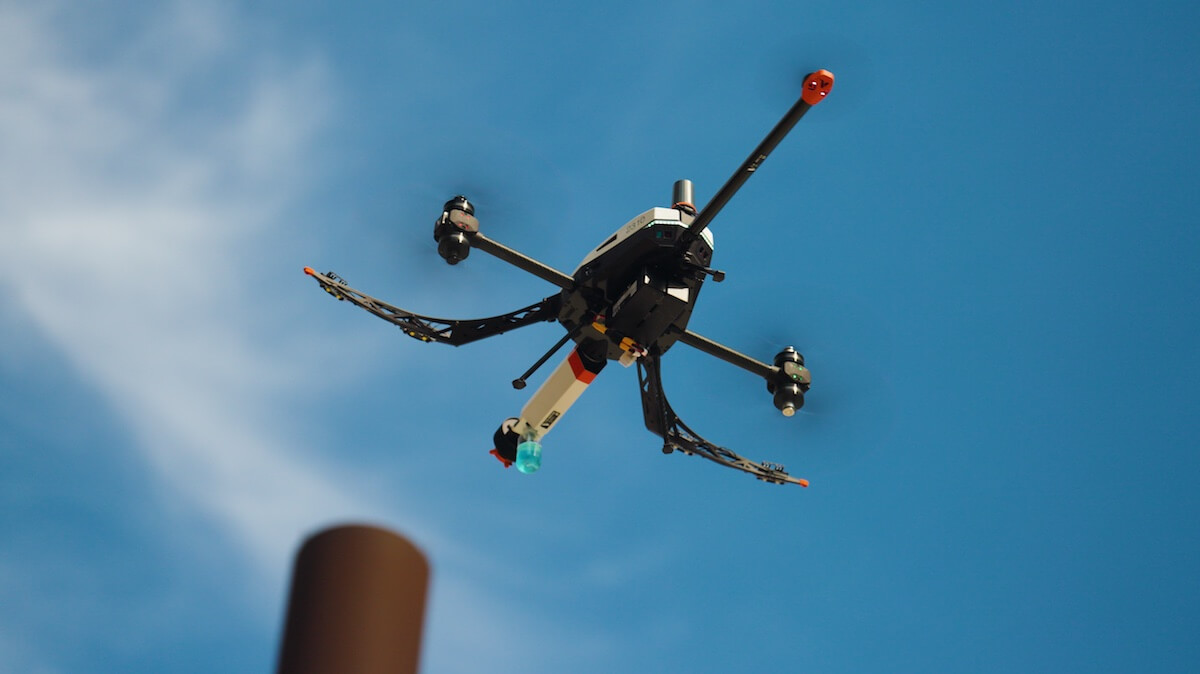
Voliro T delivers on-the-spot surface prep and coating at height, patching early-stage corrosion fast, efficiently, and effectively without scaffolding, rope access, or production shutdowns.
Spot repair is the targeted remediation of localised corrosion on industrial steel structures such as storage tanks, chimneys, stacks, pipes, and offshore platforms. Rather than stripping and recoating an entire asset, operators patch only the areas where the protective coating has failed or thinned beyond acceptable limits.
This distinction matters. Full recoating programmes are expensive, time-consuming, and typically require extensive scaffolding and production shutdowns. Spot repair is the pragmatic alternative: extend asset life quickly and cost-effectively between major turnarounds, before small rust patches become large structural problems.
The challenge has always been access. Most corrosion on industrial assets sits at height – on tank walls 30 metres up, on chimney stacks, on pipe bridges. Getting a qualified coating applicator to those locations safely, and completing quality surface preparation in the process, has historically required rope access, scaffolding, or man-lifts.
Spot repair is not a freeform activity. The most widely applied standard for surface preparation prior to coating is SSPC-SP 11 (Power Tool Cleaning to Bare Metal), which defines the minimum surface cleanliness and the minimum surface profile required for good coating adhesion.
The key requirement: a surface profile of at least 25 µm (1 mil). This roughness is what allows a coating to mechanically bond to the substrate. Without it, even a correctly specified coating will delaminate prematurely.
Once the surface is prepared, the coating must be applied to a target Dry Film Thickness (DFT) set by the asset owner’s integrity team. Common specifications for spot repairs in harsh industrial environments include 2K high-build epoxy products such as PPG Sigma Shield 880 and AkzoNobel Interzone 954.
An integrity team identifies corrosion from a visual inspection or NDT survey. They mark up affected areas and hand the scope to a coatings contractor. The contractor mobilises a rope access team or arranges scaffolding, often days or weeks later, depending on availability and permitting. The team ascends to each location, hand-tools the surface, applies the coating, and descends.
Each step carries cost and risk. Scaffold erection for a tank wall can take days and cost tens of thousands of dollars before a single patch is applied. Rope access is faster but physically demanding and subject to weather windows. Falls from height remain one of the most common causes of serious workplace injury in the industrial sector.
The result: small corrosion patches, the kind you could cover with a sheet of A4 paper, can sit unrepaired for months simply because the logistics of safe access make individual mobilisations uneconomical. By the time they are addressed, what was a spot repair has become a structural integrity concern.
Voliro’s answer is a single aerial platform: the Voliro T that executes the entire spot repair workflow from the ground. The process follows four steps: Find. Prep. Coat. Verify.
The Voliro T already carries a range of NDT payloads for inspection: Ultrasonic Testing (UT), High-Temperature UT, EMAT, Pulsed Eddy Current (PEC), and Dry Film Thickness (DFT) gauges. An operator flies directly to an area of concern, takes contact-based measurements, and quantifies exactly where corrosion is active. Inspection data defines the repair scope. Typical target patch size is approximately 30 × 30 cm (≈ 1 ft²) on flat, cylindrical, or spherical steel surfaces.
The Aeroblaster payload, co-developed with MontiPower — a global leader in mechanical surface preparation — mechanically prepares the surface using an integrated Bristle Blaster tool. The process removes corrosion and creates the surface profile required for coating adhesion.
The Aeroblaster has been externally validated to consistently achieve the SSPC-SP 11 minimum profile requirement of ≥ 25 µm, confirmed by an independent testing laboratory and reviewed by SGK (Swiss Society for Corrosion Protection) — a neutral technical authority with over 100 years of expertise in corrosion technology.
Once the surface is prepared, the Voliro T applies the specified product to target dry-film thickness. The system is compatible with industry-standard 2K epoxy products including PPG Sigma Shield 880 and AkzoNobel Interzone 954 — the same products asset owners already specify for manual spot repair programmes. No new coating qualification is required.
Every patch is documented with visual evidence and measurements, creating a traceable maintenance record. All data — images, videos, and inspection readings — is stored in the Voliro Cloud, where a full report can be generated covering the entire scope of work. Each repair is logged, timestamped, and ready to share with asset owners, integrity teams, or auditors with no manual write-up required.
The immediate benefit is operational: no scaffolding means faster mobilisation, less downtime, and fewer people at height. A patch that might take days to access conventionally can be reached within hours of the decision to repair.
Beyond speed, drone-based spot repair changes the economics of corrosion maintenance. Instead of letting patches accumulate until a mobilisation is cost-justified, operators can address corrosion as it appears, extending asset life between turnarounds and reducing the risk of unplanned shutdowns.
For inspection companies and drone service providers already operating the Voliro T for NDT work, Spot Repair is a natural expansion. The same platform that identifies corrosion can now fix it. Inspection and repair become part of a single integrated workflow, delivered by the same crew on the same visit.
The solution is currently available as an early-access service delivered by Voliro on onshore steel assets, with limited slots available in 2026.
Drone-based spot repair addresses one of the most persistent frustrations in industrial asset maintenance: the gap between identifying early-stage corrosion and being able to act on it cost-effectively. By combining aerial NDT, validated mechanical surface preparation, and precision coating application on a single platform, Voliro T delivers a complete Find. Prep. Coat. Verify. workflow from the ground.
The process meets the same standards as conventional spot repair with a validated SSPC-SP 11 surface preparation profile while delivering it faster, safer, and with a full digital audit trail.
If you manage steel assets at height and want to explore whether Voliro Spot Repair fits your maintenance programme, contact the team with your asset type, site location, target coating system, and estimated patch count to schedule a scoping conversation.
The Voliro Aeroblaster payload is validated to meet SSPC-SP 11 (Power Tool Cleaning to Bare Metal), achieving a surface profile of ≥ 25 µm. This has been confirmed by an independent external testing laboratory and reviewed by SGK, the Swiss Society for Corrosion Protection.
Voliro T is compatible with industry-standard 2K high-build epoxy products including PPG Sigma Shield 880 and AkzoNobel Interzone 954. Asset owners can use the same coating systems already specified for their manual spot repair programmes.
The typical patch size is approximately 30 × 30 cm (about 1 ft²). The solution is optimised for flat, cylindrical, or spherical onshore steel surfaces such as storage tanks, stacks, chimneys, pipes, and structural supports.
The current Voliro T platform is optimised for static onshore assets. Offshore and FPSO applications are on the product roadmap but are not within the current operating envelope. Each offshore opportunity is evaluated case by case.
Every patch is documented with images, video, and optional DFT measurements stored in the Voliro Cloud. A full inspection and repair report can be generated automatically, covering the entire scope of work with timestamps and location data ready to share with asset owners, integrity teams, or auditors.