Gash Group conducted a drone-based wall-thickness inspection at Heidelberg Materials’ cement plant in Nazareth, Pennsylvania, using the Voliro T equipped with an EMAT payload. The scope covered the kiln, clinker cooler and downcomer: heavily rusted, elevated steel, measured at twice the density of previous inspections and without technicians at height.
During the inspection, the team had visually detected a crack on the downcomer. Only 2ft was visible externally, but after further inspection with the Voliro T, the readings showed that it had extended to approximately 6 feet beneath the surface.
Within minutes of these findings, the team had exported a report to bring up to Miguel the reliability manager. This type of information is invaluable as a plant this size having a shut down can result in $180,000 to $340,000 a day in lost revenue. Especially if repairs then stretch over several weeks.
Miguel immediately made a phone call to the scheduled repair team to notify them that the repair originally prepared to execute would no longer be adequate and to expand the scope.
During these few days of inspection, the Gash Group also digitized the entire facility with LiDar, photogrammetry and thermal data, delivering a 3D digital twin of the site as well as 3D models of all three inspected assets.
Each new Voliro T inspection will be added to the same site digital model, gradually building a fully digitized record of the facility that the plant’s teams can review by asset and by year.
Reduced downtime risk worth up to $340K a day. Sizing the downcomer crack before the repair helped Heidelberg Materials avoid a second repair and a potential unplanned shutdown. Next, the plant plans drone pre-inspections so repairs can start on day one of its annual shutdown.
High-density thickness mapping at height. With the Voliro T, Gash Group flew straight to elevated, hard-to-reach areas on the kiln, clinker cooler and downcomer. On the kiln alone, that meant 152 EMAT readings in about four hours, at twice the usual density, through heavy rust.
Inspection workflow efficiency. In about two days on site, Gash Group collected NDT readings every 4 ft, plus LiDAR, photogrammetry and thermal data. One team, one visit and one 3D digital twin covered work that would normally need several contractors.
Zero work at height. Every contact measurement was taken by the Voliro T, with Gash Group’s pilots on the ground. The plant didn’t have to shutdown, build and remove scaffolding, lifts or rope access.
Cement plants run continuously, and their maintenance windows are valuable. The kiln line is exposed to heat, abrasion and corrosion, and much of it sits high above the ground, wrapped in piping and steelwork.
Reliable wall-thickness data is essential for planning repairs, but collecting it has traditionally meant putting people where the steel is.
We’re not just obtaining photographs of those locations. We’re collecting actual material condition measurements that can be incorporated into a digital 3D model inspection record.” Brandon Gash, CEO of Gash Group.
Gash Group set out to change that. The company captures and delivers inspection-grade data for energy, industrial and telecom infrastructure, combining Voliro’s drone-based NDT with LiDAR, photogrammetry and thermal imaging.
For contact measurements, its team flies the Voliro T, a drone designed to hold several NDT probes in steady contact with a surface at any angle.
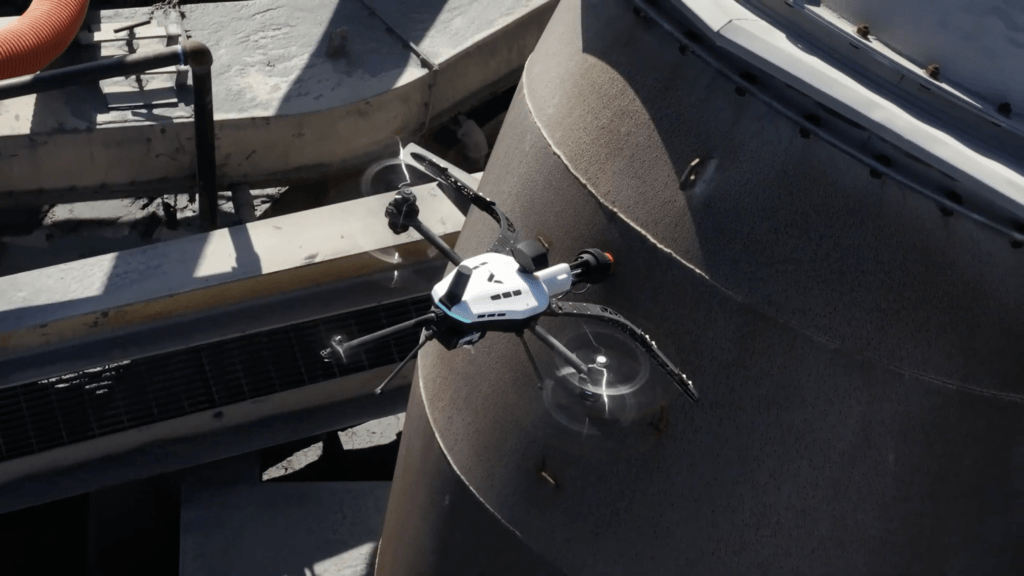
Heidelberg’s cement plant needed a clearer picture of the structural condition of its kiln, clinker cooler and downcomer, where significant corrosion and material loss had been observed.
Maintenance and engineering teams needed reliable thickness data to identify deterioration and plan repairs.
You have no idea how valuable this is to us. This data helps us focus on the repairs that are really needed and see damage that isn’t visible from the outside.” Miguel Ramos, Reliability Manager, Heidelberg Materials
Because of the corrosion, the plant also asked for more detail than before. Previous inspections had taken readings roughly every 8 ft. This time the plant requested 4 ft spacing along each inspection path, doubling the number of measurement points.
With traditional NDT inspection methods, each of those points has to be reached by a technician. Depending on the structure, that means scaffolding, elevated platforms or rope access, along with the planning, personnel and work-at-height exposure that come with them.
The biggest challenge is obtaining accurate, repeatable NDT measurements on surfaces that weren’t necessarily designed to be accessible for inspection,” Timothy, Director of Sales & Business Development at Gash Group.
Gash Group approached the two days scope of work as one coordinated inspection rather than a set of separate services:
Voliro T equipped with the EMAT payload. Gash Group’s pilots operated the Voliro T fitted with an EMAT (electromagnetic acoustic transducer) payload for the full inspection. EMAT generates the ultrasonic wave inside the steel with a magnet and a coil, so it needs no couplant or surface preparation. On rusted surfaces like these, conventional UT would have meant grinding every point back to bare metal first. Using the Voliro’s omnidirectional flight made steady contact with surfaces at different angles, reaching elevated and complex sections of the kiln system and downcomer, including the downcomer’s upper ridge. On the kiln alone, the team collected 152 wall-thickness readings at 4 ft spacing in about four hours, reviewing results on site as they came in.
LiDAR, photogrammetry and thermal in the same visit. Alongside the NDT, the team captured LiDAR for accurate geometry and spatial mapping, photogrammetry for high-resolution visual models of the equipment, and thermal imaging to highlight temperature anomalies. Together, these layers recorded the entire facility as it stood on the day of the inspection.
One 3D digital twin. Gash Group’s own software brought every layer together into a 3D digital twin of the site, with detailed models of the kiln, clinker cooler and downcomer. Each Voliro T reading can be opened from its location on the model, with the A-scan available at a click, so findings are reviewed in context rather than in a spreadsheet.
The inspection produced two distinct findings, and the difference between them shows the full value of the approach:
The kiln: a known crack. On the kiln, the plant had already identified a crack and was planning its repair. Gash Group’s high-density readings gave the maintenance team detailed wall-thickness data across the kiln to support that work.
The downcomer: a damage no one knew about. The downcomer findings were not a part of the original inspection scope. The plant had been dealing with a loss of pressure escaping the systems without a trace to the source. While the team was flying the site they spotted not one but two cracks on the downcomer. Each were a couple feet long externally. The team then operated the Voliro T and took a series of reading around each. As a result it was found that one of the cracks ran about six feet beneath the surface. Most of it had been hidden beneath the concrete.
It was a perfect example of how inspection data can influence a maintenance decision rather than simply document a problem after the fact.” Brandon Gash, CEO, Gash Group
Heidelberg Materials already had a repair scheduled for that area, sized for the one to two feet that could be seen. Based on the Voliro T findings, the plant expanded the repair to six feet.
Finding the full length of that crack before the repair changed the job. Without the Voliro T data, we would have fixed 2 ft and missed the rest. That kind of information is extremely valuable to us.” Miguel Ramos, Reliability Manager, Heidelberg Materials
In the model, users can select a measurement point, open its Voliro inspection data and apply colour-coded severity filters to find areas of concern at a glance.
Maintenance, engineering and plant management review the same information in one place, instead of working through separate reports and drawings.
We didn’t just inspect three assets. We digitized the whole facility, so every finding has its place in one 3D model. That full-site view is what sets our work apart.” Timothy, Chief Sales Officer at Gash Group.
For this project, the full-site model was delivered as a proof of concept. In future inspections, every Voliro reading will sit inside the same site model. Plant teams will be able to click on the kiln, the clinker cooler or the downcomer and choose the inspection year they want to see, much like browsing a location’s photos over time on an online map, but with inspection data.
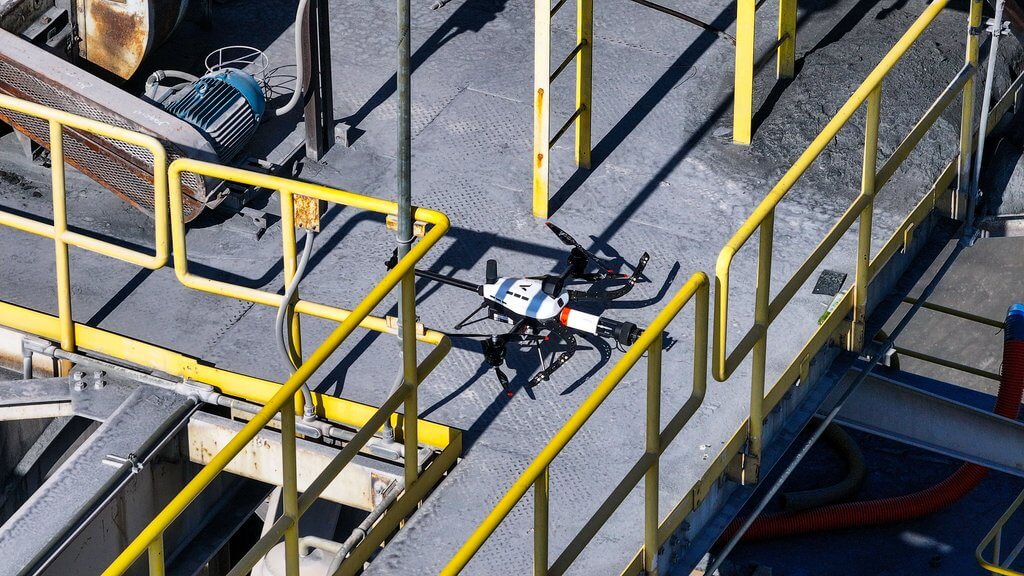
With this project, Gash Group delivered twice the measurement density of previous inspections, contact thickness data from areas that are hard to reach by conventional means, a full-site digital twin, and the evidence Heidelberg Materials needed to size its repair around the true extent of the damage.
That record is also the starting point for what comes next. Using Voliro’s Repeatability features, Gash Group can re-measure the same points on future visits and add the results to the same model. Over time, the plant can see where wall thickness is changing and how fast, and move from reactive repairs towards condition-based maintenance.
The same approach applies well beyond cement, from power generation and renewables to oil and gas, petrochemicals, steel and mining.
One inspection tells you where the plant stands today. Every inspection after that tells you where it’s heading. That’s what we’re building with Heidelberg.” Brandon Gash, CEO of Gash Group.
Voliro develops the Voliro T, the world’s first omnidirectional robotic drone capable of applying controlled force in any direction. Designed for contact-based inspection and maintenance of complex structures, the Voliro T carries NDT payloads such as EMAT and ultrasonic testing. This lets service providers like Gash Group measure wall thickness on elevated, hard-to-reach assets that previously required scaffolding, lifts or rope access teams. With repeatable measurement points, inspections can be repeated over time to track how asset condition changes. The Voliro T is used across cement and heavy industry, oil and gas, power generation, wind energy and infrastructure worldwide.
Visit www.voliro.com to learn how operators and service providers around the world are making contact-based drone inspection the new standard for asset integrity.
Gash Group is an industrial drone intelligence company that turns complex sites into decision-ready data. Its team combines drone-based NDT with LiDAR, photogrammetry, thermal and visual imaging, and delivers the results as digital twins, point clouds and 3D asset models with inspection points placed directly on the structure. Gash Group serves energy, utilities, refineries and industrial plants, telecom, rail and construction materials, with a safety-led, objective-driven approach built around the decision each client needs to make.
Visit gashgroup.org to plan your next inspection.


