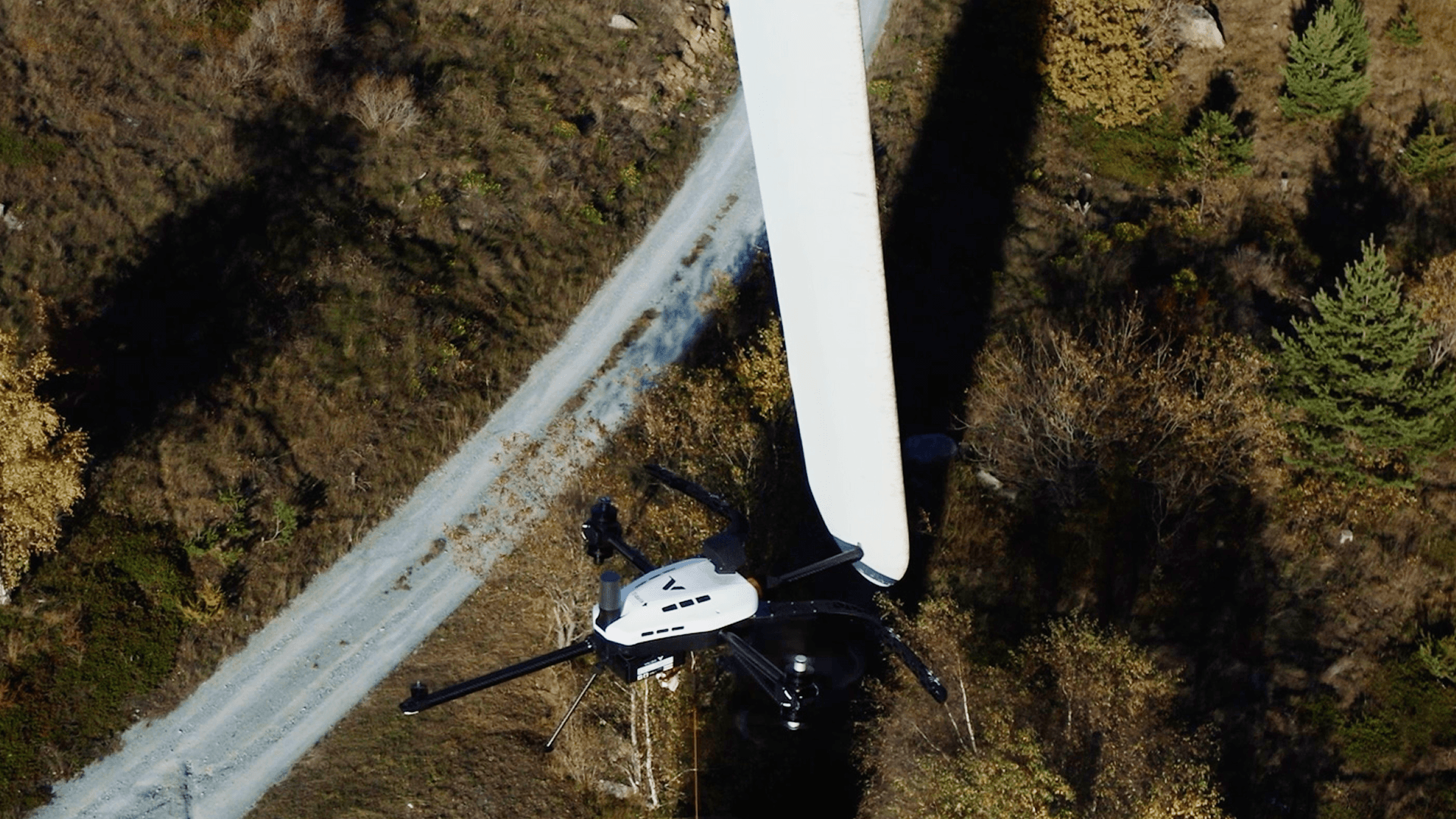
The high-voltage tester, built into the Voliro LPS ground station, ramps to ~15,000 V to bridge spark gaps as a lightning strike would and reports breakthrough voltage without nacelle climbs, lifts, or rope access.

Trusted by industry leaders
Voliro’s LPS tester uses a 4 wire microohmmeter measurement device to measure the resistance of the LPS system with a very high precision.
The high-voltage LPS tester applies an increasing potential from 0 to 15kV to find the voltage that breaks through the discontinuities. Extending measurement capabilities where the resistance is to high for a microohmmeter to inspect.
The high-voltage LPS tester does not replace the previous solution, it complements it. It gives confidence that an open circuit could not be bridged even by higher voltages, it can give indicative results without bridging spark gaps bit does not provide a high quality resistance measurement as the microohmmeter device
High-voltage LPS testing verifies that a wind turbine blade’s lightning-protection path is continuous from tip receptor to root by applying a high test voltage (~15,000 V) instead of a low-voltage resistance measurement. The voltage is high enough to arc across an air gap, so it bridges the spark gaps built into many blades, the same gaps that make a low-voltage microohmmeter read a false open circuit.
Yes. Both methods run from a single Voliro LPS ground station, with the option to auto-switch between low-voltage (LV) and high-voltage (HV) mid-flight. High-voltage is enabled by software as an add-on to the existing LV solution, so no additional hardware is required.
High-voltage testing is used where a low-voltage microohmmeter can’t reliably verify the path principally Enercon turbines, thick-coated Nordex blades, and Vestas turbines using a Lightning Current Transfer Unit (LCTU). It also serves as a confirmation step on any turbine, to establish whether an open-circuit reading is a real defect or an artifact of a spark gap or coating.
Voliro’s AIM recognizes LPS receptors and contacts each one on the first attempt, so the operator isn’t manually aligning the payload against each receptor.
Voliro’s published figures cite roughly 20–30 minutes per turbine for LPS testing, with downtime limited to the measurement window
LPS continuity testing on wind turbines is governed by IEC 61400-24.