Lightning strikes are one of the most damaging and underestimated threats facing wind turbine operators. For CVA (Compagnia Valdostana delle Acque), one of Italy’s leading 100% renewable energy producers with over 25 years of experience, 1,000+ MW of hydroelectric capacity, and a growing portfolio of 81 wind turbines.
The first Italian region to achieve fully local water and hydroelectric management. The cost of lightning damage had reached hundreds of thousands of euros. The solution came from an innovative approach: Tidalis’ drone-based Voliro T technology.
We spoke with Filippo, Head of Renewable Energy Operations at CVA’s subsidiary Aqua EOS, about how he discovered Voliro’s drone-based LPS (Lightning Protection System) continuity testing, why traditional methods were economically unworkable, and what the results have meant for his fleet.
The Lightning Protection System (LPS) is the network of conductors built into a wind turbine blade that safely discharges the energy of a lightning strike to ground at the tower base. If any part of that system is broken or degraded the blade is unprotected, and a strike can cause catastrophic structural damage.
LPS continuity testing verifies that the electrical circuit from blade tip to tower base is intact and uninterrupted. Traditionally, this required an aerial work platform (a crane or lift) to physically reach the blade receptors. With Voliro T drone technology, the same test can be completed in a single flight without stopping the turbine and without heavy ground infrastructure.
My name is Filippo and I have been Head of the Renewable Energy Operations function, covering all wind and photovoltaic plants in the group. I have actually been working in this operational role for more than ten years, always focused on the day-to-day management of our assets: daily operations, routine maintenance, and extraordinary maintenance across all our plants.
CVA has been producing, distributing, and selling 100% renewable energy for over twenty years. Our core business is hydroelectric power in the Aosta Valley.
In recent years, as climate change has brought reduced snowfall that affects the water reserves feeding our hydro plants, we have diversified into wind and solar. Italy – especially the South – has a lot of wind and a lot of sun, and as a Mediterranean country it is a European leader in renewable energy production from both sources.
We currently manage 81 wind turbines totalling nearly 197 MW of installed capacity, alongside our growing solar portfolio.
The approach we have always taken is to keep our plants operational as much as possible — minimising downtime and maximising production.
Over the years, we identified a serious recurring problem on our wind assets: blade damage caused by lightning strikes.
The costs were significant on two fronts:
First, direct repair costs, in some cases we had to replace blades entirely. At CVA we have had to replace three blades, and we are talking hundreds of thousands of euros per replacement.
Second, lost production during the downtime required for repairs.
This pushed me to ask: how can we ensure that the LPS — the system that discharges lightning energy safely to ground — is actually functioning? If we can detect a failing LPS before a strike occurs, we prevent the damage entirely.
The conventional method for LPS continuity testing uses an aerial work platform — essentially a very large crane or lift — to physically reach the blade receptors.
The problem is that many of our wind farms sit on difficult terrain: remote sites with narrow access roads, limited space around the turbine base, and no room for the civil works needed to position a 100-metre platform.
When I investigated this route, the economics were simply not viable. We were being quoted approximately €5,000 per turbine for a single measurement.
With 81 turbines under management, that amounts to over €400,000 just to test the full fleet once. The costs were not sustainable.
So I started looking at what else existed on the market — and almost by chance, I came across Tidalis, and through them, Voliro.
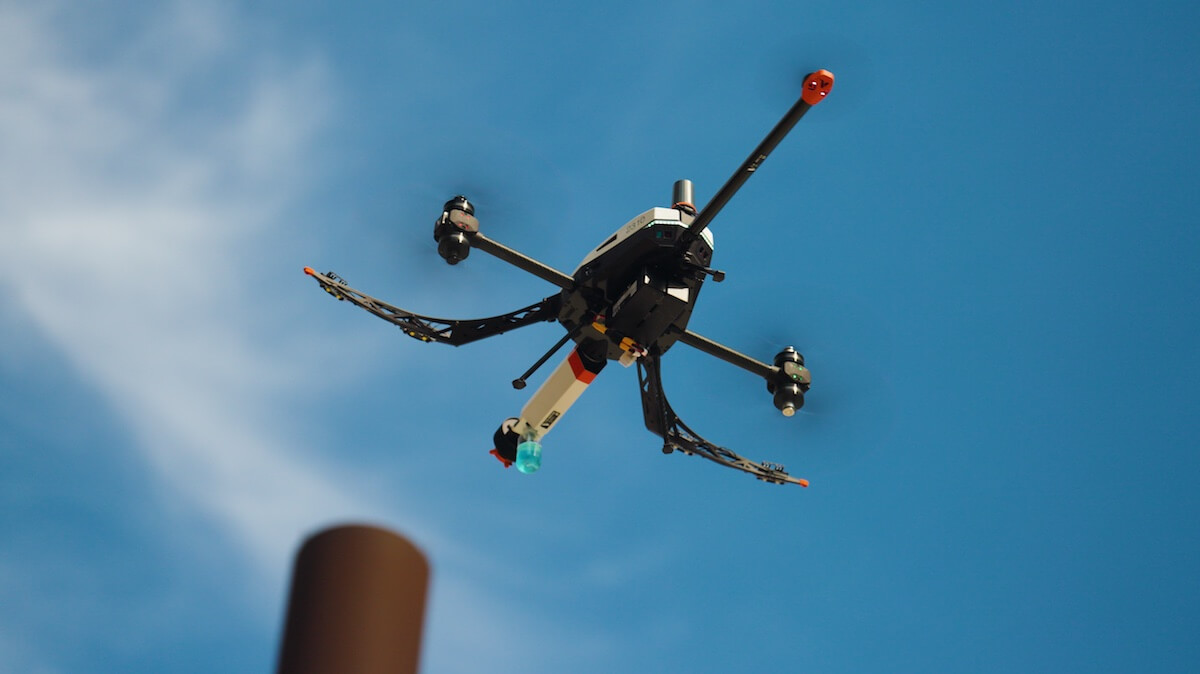
The Voliro T drone approaches what are called receptors — small metallic discs installed on the blade, primarily at the tip, and then at intervals along the blade depending on its length. A typical blade has seven, eight, or nine receptors depending on the rotor diameter.
Using a specialised nose probe, the drone injects a small current into the LPS system at each receptor. The circuit is closed at the tower base on the exterior, allowing us to measure the electrical continuity of the entire system from tip to base. If continuity is confirmed across all receptors, we know the LPS is functioning correctly and that there are no weak points where a lightning strike could cause damage.
All three blades of a single turbine can be tested in a single drone flight.
Before committing to any new technology, I always prefer to see it working in real conditions. In 2022, we travelled to Zurich to visit Voliro. About half an hour north of Zurich, they took us to a small wind farm where we watched a live measurement being performed on a real turbine blade. That was the first time I had seen it done in practice.
After observing the on-site measurement, and after visiting Voliro’s offices and laboratories in Zurich, I came away convinced. We had found a cost-effective technology that would allow us to maintain continuous oversight of our LPS systems across the entire fleet.
The way we came to know Voliro was itself almost accidental: the original contact came because they had asked if they could use our wind farm to give their pilots practical training hours.
That particular arrangement didn’t happen, but the conversation gave us the chance to understand their technology — and from that we went on to conduct what became the first drone-based LPS measurement activity in Italy.
We have now been working with Tidalis – a leading Drone-as-a-Service (DaaS) provider using the contact-based drone technology Voliro T – for several years who have completed measurements on nearly all 81 of our turbines.
The results are satisfactory, giving us a clear and reliable picture of the LPS condition across the entire fleet.
The impact falls into three areas:
– Cost. Using the Voliro T Tidali’s inspections eliminate the civil works, platform rental, and logistics costs that made traditional testing unworkable. For our wind turbine fleet, the difference between ~€5,000 per turbine via aerial platform and the drone-based approach is transformative. It makes systematic fleet-wide testing economically viable for the first time.
– Downtime. Tidalis usually can inspect all three blade measurements in a single flight with minimal turbine downtime. Traditional platform-based testing required significantly longer machine stops.
– Prevention. Thanks to Tidalis using the Voliro Twe can include more regular and systematic LPS monitoring across an entire fleet realistically for the first time. Knowing the LPS is functioning before a lightning season means CVA can intervene proactively. Replacing or repairing a degraded receptor is a fraction of the cost of replacing a blade.
That consistency of coverage, at scale, is what meaningfully extends the operational lifespan of the wind turbine generator itself.
Yes, on several occasions. Lightning damage came up repeatedly in technical working groups and industry meetings. It is a growing problem across the Italian wind sector. I have recommended this system to operators at other companies because I genuinely believe that preventive and predictive inspection is fundamental in our line of work.

I believe that preventive and predictive maintenance activities — such as blade inspections or LPS measurement with drones — help you define your maintenance horizon and allow you to work with much greater peace of mind, because you know the condition of every machine in your fleet.”
Filippo, Head of Renewable Energy Operations, CVA / Aqua EOS
Voliro’s technology is genuinely at the forefront in Italy. CVA was a pioneer, the first operator on Italian territory to adopt drone-based LPS measurement and I think the wider sector still has significant catching up to do.
In other industries, drone-based inspections are already standard practice. I hope that in wind energy, beyond conventional visual blade inspections, non-destructive testing of blades, generators, and structures using drones becomes the norm.
Wind turbines are complex machines that have always required lifting equipment to access their critical components. The drone changes that fundamentally it reaches components that would otherwise be extremely difficult and expensive to inspect, quickly, safely, and economically.
What is LPS continuity testing on a wind turbine? LPS (Lightning Protection System) continuity testing verifies that the electrical pathway from the blade tip to the tower base is intact. A complete, unbroken LPS means a lightning strike is safely discharged to ground rather than causing structural damage to the blade.
How often should wind turbine LPS systems be tested? Industry practice and the experience of operators like CVA points toward regular periodic testing rather than waiting for visible damage to appear. Constant monitoring significantly reduces the risk of catastrophic blade loss.
What happens if an LPS system fails during a lightning strike? Without a functioning LPS, the energy from a lightning strike cannot be safely discharged. This can cause severe structural damage to the blade — in some cases requiring full blade replacement. CVA has had to replace three blades due to lightning-related damage, at a cost of hundreds of thousands of euros per replacement.
Is drone-based LPS testing approved for use in Italy? CVA / Aqua EOS was the first operator in Italy to use drone-based LPS continuity measurement, establishing the approach as viable and effective in the Italian market. They have since tested nearly all 81 turbines in their fleet with a 95% satisfactory result rate.
What wind turbine brands is Voliro compatible with? CVA operates turbines from Vestas, Siemens Gamesa, General Electric, and ENEL all tested successfully using Voliro’s drone-based system.